
In October 2021, my partner and I decided to see the beautiful Sumidero Canyon in the state of Chiapas, Mexico. We flew from Mexico City to Tuxtla Gutierrez, the largest and fastest growing city in the state of Chiapas and its capital. Chiapas is home to the Sumidero Canyon and prominently appears on the state seal.
The flight to Tuxtla was short and uneventful and we landed in the small Tuxtla International Airport. The airport is quite far from the city of Tuxtla and the taxi ride to the city took nearly 40 minutes. We had rented an Airbnb apartment in Tuxtla and though spacious, we soon found out that we needed numerous keys to get in and out, the air conditioning in the bedrooms was not working and there were no dishes in the kitchen to either cook with or heat the food. It was not close to the center of town or convenient for shopping. Of course, we should have investigated all this before renting it. Well, live and learn. Much to the surprise of the owner, we decided to forego the rent and move to a hotel. That was a good decision as it had a microwave, a refrigerator, and the air conditioning was working!
We spent one day exploring the Parque Marimba, Dr. Faustino Miranda Botanical Garden, the Paleontology Museum next door and the San Marcos Cathedral in the city center. The botanical garden is well worth a visit. The next day we visited the Sumidero Canyon.


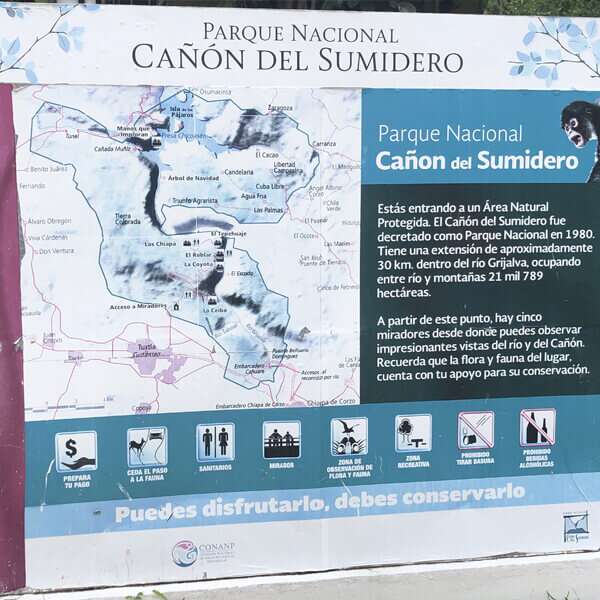


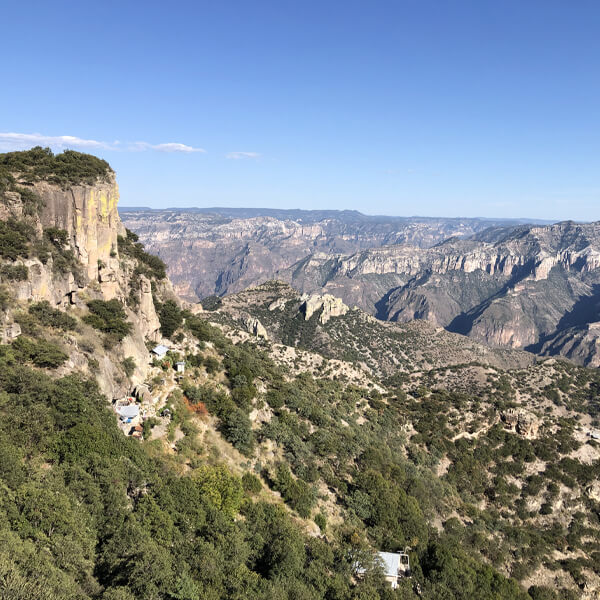
Formation of the Sumidero Canyon started 12 million years ago with a geological fault and subsequent erosion by the Grijalva river formed the canyon walls that in places can reach heights over 1000 m. The area around the canyon is the Paque Nacional Canon del Sumidero, a federally protected area. Entrance to the park is conveniently located close to the city of Tuxtla and public transportation is available up to the entrance but not inside the park. There are several viewpoints or miradores where you can park your car and walk a few hundred meters and get panoramic and breathtaking views of the canyon. Total distance from the park entrance to the last viewpoint is over 16 km and it will be a very arduous walk without a car. La Ceiba is the beginning of the canyon and the first viewpoint. Other viewpoints are La Coyota, El Roblar, Tepehuaje, Los Chiapas, and Manos Que Imploran. The last viewpoint has a watch tower, souvenir shops, restrooms, and a small restaurant. From several viewpoints you can see the Grijalva river winding its way through the canyon and boats plying the river below.
The next day, the same taxi driver took us to Chiapa de Corzo, a Magic Town from where you can take a boat trip on the Grijalva river. There are several piers from where boat tours start and Malecon Pier is the busiest. Boats can be hired for group and private tours. Group tours are less expensive than private tours and sometimes there is a long waiting time to get enough passengers. We did not have that much time and decided to hire a private boat. Seeing the canyon from the river is an entirely different experience than seeing it from the viewpoints above. Watching the towering walls of the canyon from the river is a unique experience. The boat made stops at key locations to see points of interest such as the “Christmas Tree Waterfalls” and the “Cave of Colors”. The endpoint of the boat tour is the Chicoasen Dam, where hydroelectric power is generated using several Francis turbine-generators. A monument for the workers who built the dam can be seen and the boat turns around from this point and goes back to the launching point near Chiapa de Corzo. Make sure to wear plenty of sunscreen and hang on to your hat during the boat trip! My partner’s hat flew off, but the captain turned the boat around and retrieved it. Of course, it had to be washed before it could be worn again!




The city center of Chiapa de Corzo has a clock tower, a brick rotunda and a statue of Zeferino Nandayapa Ralda, a Mexican folk and classical marimba player playing the marimba. Nearby there is also a small quaint white church you can visit.
On the last day in Tuxtla we visited the Glorioso Cristo de Chiapas (Cristo de Copoya) on our way to Villahermosa to see Palenque. (I plan to write about it in a later blog article) The 62-meter tall cross with an image of Christ is the largest in all Mexico and was designed by the Mexican architect Jaime Latapí López. Originally conceived by Monsignor Felipe Aguirre Franco, then Bishop of the Diocese of Tuxtla in 1997, it was not completed until 2011 due to cost overruns and delays in acquiring the protected land where the cross was to be built. Key events in the life of Jesus Christ are shown along a walkway. You can get panoramic views of the city of Tuxtla and can also enjoy a snack or a cup of coffee in the restaurant at the base which we did. Interestingly, the first letter T in the Tuxtla city logo has an image of the Cristo de Chiapas.
Sumidero Canyon is every bit as magnificent as described by many websites. You will cherish your visit as a once in a lifetime experience. Guaranteed!




Leave A Comment